Trading and distribution companies
Businesses managing stock, purchase orders and sales across warehouses, branches or channels.
Finance, sales, purchasing, inventory and HR connected in one system. Upscaleads delivers ERP Solutions for businesses in Dubai and across the UAE.
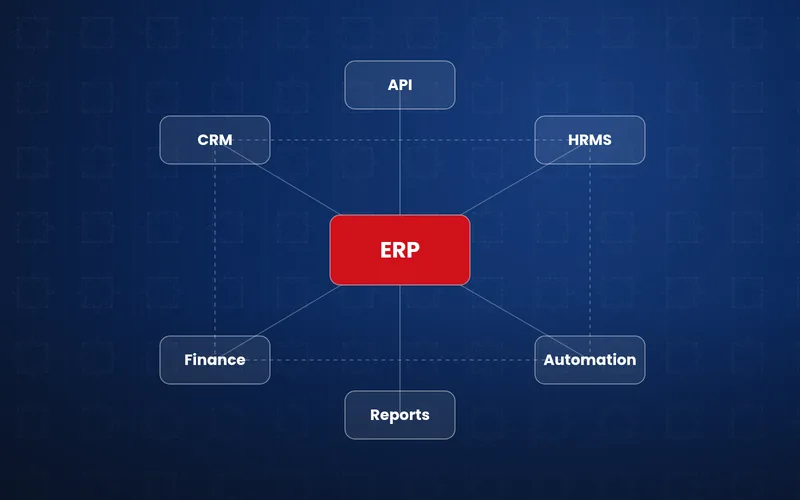
ERP solutions are software systems that connect a company's core functions, such as finance, sales, purchasing, inventory and HR, so every team works from shared data. Implementation involves mapping processes, selecting or building modules, migrating data, integrating other systems, training users and rolling out in phases. Upscaleads provides custom and platform-based ERP solutions in Dubai.
An ERP (Enterprise Resource Planning) system connects the core functions of your business, so everyone works from the same data. We develop custom ERP solutions covering finance and accounting, sales, purchasing, inventory, HR, CRM and project management.
Workflow automation removes repetitive tasks, while reporting and business intelligence give leadership a real-time view of performance.
We integrate your ERP with third-party systems and roll it out in phases to reduce disruption.
Businesses managing stock, purchase orders and sales across warehouses, branches or channels.
Companies running separate tools for accounts, sales and inventory that do not share data.
Businesses where manual reconciliation and duplicated data entry are slowing growth.
Owners and directors who want up-to-date reports without waiting for each department to compile them.
12 deliverables, scoped to your goals.
A structured process, with clear communication at every stage.
Document how work flows today, where time is lost and what data matters.
Define modules, user roles, integrations and a phased roadmap.
Develop in short cycles with regular demos and feedback.
Move and clean existing data from spreadsheets or legacy tools.
Train your team and support adoption during launch.
Maintenance, improvements and new modules as you grow.
We document how your business actually runs before choosing modules, so the ERP fits your operations.
We advise whether a platform such as Odoo or a custom ERP suits your processes and budget.
Modules go live in stages with training, so daily operations keep running during the change.
We also build CRMs, e-commerce stores and integrations, so your ERP connects cleanly with them.
An ERP system is software that brings core business functions, such as finance, sales, purchasing, inventory and HR, into one connected platform with shared data.
Usually when departments rely on separate spreadsheets or tools, data is duplicated, and leadership lacks a clear, real-time view of operations.
Yes. We often start with the modules that create the most value and add others over time.
Yes. Third-party integrations connect your ERP with e-commerce, payment, CRM, accounting and other systems.
ERP cost depends on the number of modules and users, whether you use a platform or a custom build, how much customisation your processes need, data migration from existing tools, integrations and training. Licences, hosting and support are ongoing costs. We provide a tailored quote after a consultation and process review.
A CRM manages leads, customers and the sales pipeline. An ERP manages the wider operations of a business, including finance, purchasing, inventory and HR. Many ERPs include a CRM module, while some companies run a separate CRM integrated with their ERP. The right setup depends on your sales process and operational complexity.
Yes. The ERP can apply the standard 5% UAE VAT rate, as well as zero-rated and exempt treatments where they apply, and produce tax invoices showing your TRN and the required details. It records input and output VAT and generates reports that help your accountant prepare VAT returns. We configure tax settings with your accountant or tax adviser to match your business activities.
We build ERP systems so they can adapt to the UAE's e-invoicing programme, which is being introduced in phases. That means structured invoice data, clean customer and tax records, and the ability to connect with an accredited service provider when your business is required to. Because the detailed rules and deadlines are set by the authorities, we review the latest requirements with you and your tax adviser.
Yes. We can implement, configure and customise open-source ERP platforms such as Odoo, including accounting, sales, purchasing, inventory and HR modules, plus the custom features and integrations your business needs. We also advise when a fully custom ERP is a better fit. Either way, the system is set up for UAE requirements such as VAT and bilingual documents, and you keep ownership of your data.
Yes. The ERP can manage several companies or branches in one system, each with its own accounts, VAT settings, warehouses and users, while producing consolidated reports for the group. It also supports transactions in multiple currencies, such as AED, USD and other GCC currencies, with exchange rate handling. This suits UAE businesses trading across emirates, free zones or wider GCC markets.
Yes. The inventory module tracks stock levels in real time across warehouses, shops and vehicles, with transfers, barcode scanning, batch or serial numbers, and expiry dates where relevant. Reorder alerts help prevent stock-outs, and valuation reports feed directly into accounting. Sales and purchasing teams see the same live figures, which reduces overselling and time spent on manual stock counts.
We start by agreeing a cut-over date, then transfer your chart of accounts, opening balances, customers, suppliers, products, open invoices and, where useful, historical transactions. We clean and map the data, run a trial migration and reconcile the figures with your accountant before going live. This keeps your books consistent and lets you close the old system with confidence.
For most growing UAE businesses, cloud hosting is the practical choice: staff can work from any location, backups and updates are simpler, and there is no server hardware to maintain. On-premise can suit companies with strict internal IT policies or specific regulatory needs. We explain the trade-offs for your situation, and either way the system and its data belong to you.
Adoption is planned from day one. We involve key users during design, keep screens simple for each role, and provide hands-on training in English or Arabic, plus short guides and videos. After launch we offer a support period to answer questions and fine-tune workflows. Management dashboards can also show system usage, so you can spot teams that need extra help early.
Practical articles from our team on this topic.
A phase-by-phase guide to ERP implementation for growing companies, covering scope, data migration, testing, training, UAE tax readiness and common pitfalls.
An honest comparison of custom-built and off-the-shelf CRMs, with the trade-offs on cost, flexibility and ownership, plus a framework for deciding which suits your business.
Ten practical automation examples across sales, finance, HR and operations, with the tools involved and a simple framework for deciding what to automate first.
Book a consultation to map your processes and plan an ERP that brings your departments onto shared data.